Introduction
Data is no longer just a byproduct of business-it has become the backbone of decision-making, operations, and customer engagement. As organizations generate and store more data than ever before, the need for reliable, scalable, and cost-efficient storage solutions is intensifying. This is where Network Attached Storage (NAS) is stepping into a more strategic role.

NAS systems, once seen as simple file-sharing tools, are now evolving into intelligent data hubs. Businesses, from startups to large enterprises, are using them to manage workloads, support remote teams, and enable faster data access across distributed environments. What’s driving this shift is the growing complexity of IT ecosystems and the demand for seamless integration between on-premise and cloud environments.
Understanding the emerging market trends is critical right now. As technologies like AI, edge computing, and hybrid cloud reshape data infrastructure, NAS is being redefined. Companies that align with these changes early are more likely to unlock efficiency, reduce costs, and gain a competitive edge.
Market Overview Snapshot
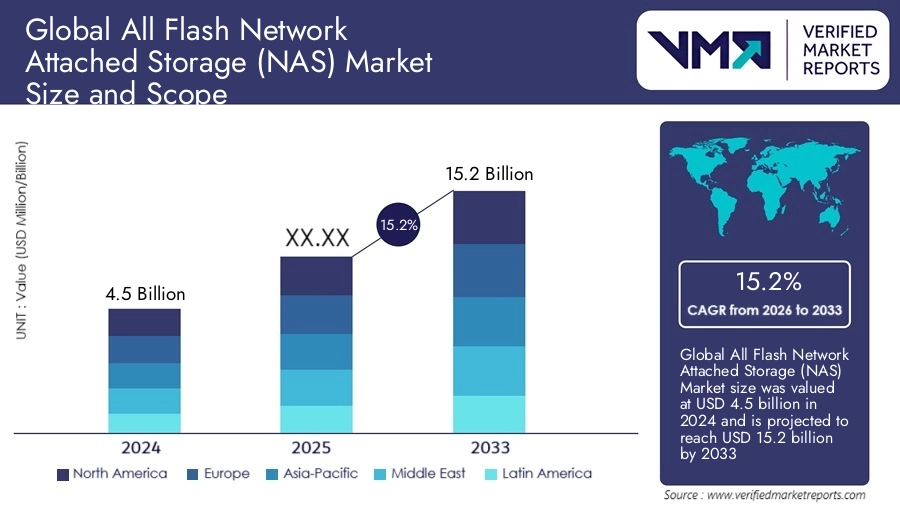
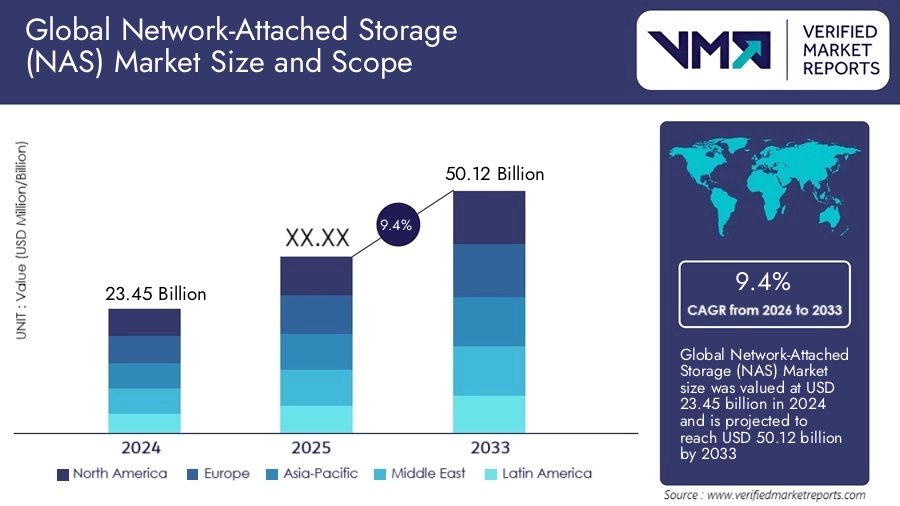
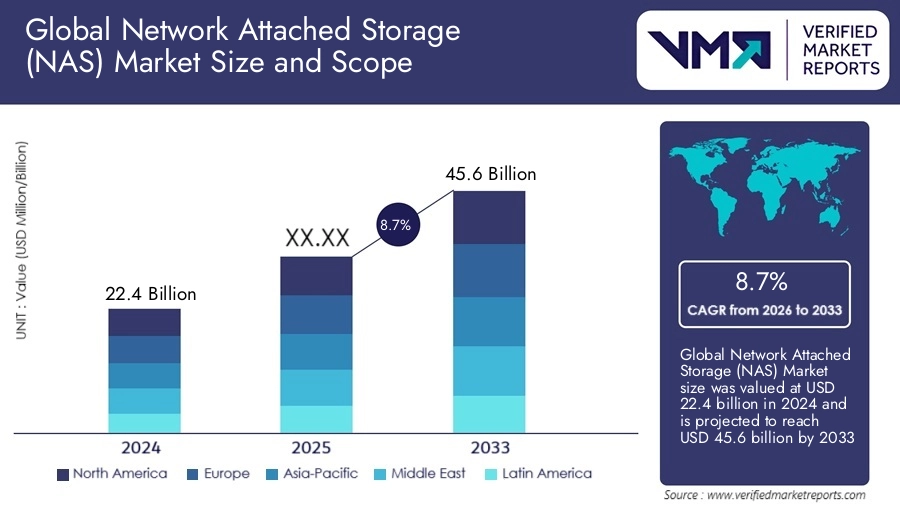
The NAS market is entering a phase of steady expansion, fueled by the explosion of unstructured data and the need for decentralized storage systems. Businesses are increasingly shifting away from traditional storage architectures toward flexible and scalable solutions that NAS provides. Small and medium enterprises are also adopting NAS at a faster rate, thanks to declining hardware costs and simplified deployment models.
- Market Size (2026): USD 35-40 Billion (estimated)
- Forecast Value (2034): USD 80–90 Billion
- CAGR: 9-11% (approx.)
- Key Growth Driver: Rising demand for scalable, cloud-integrated storage solutions
Key Takeaways
- Hybrid cloud integration is redefining how NAS systems are deployed and managed.
- AI-enabled storage optimization is improving efficiency and performance.
- Edge computing is pushing NAS adoption closer to data generation points.
- SMEs are becoming a major demand driver due to affordability improvements.
- Cybersecurity features are now a core requirement in NAS solutions.
- Subscription-based models are changing purchasing behavior.
Top Trends
1. Hybrid Cloud NAS Integration
- Overview: Businesses are increasingly combining on-premise NAS with cloud storage to create hybrid environments. This allows them to balance performance and scalability while keeping costs under control. The ability to seamlessly move data between local storage and the cloud is becoming essential as workloads fluctuate. This trend is important now because organizations want flexibility without sacrificing control over critical data.
- Why This Trend is Emerging: Companies need scalable storage without over-investing in infrastructure. Cloud platforms provide elasticity, while NAS ensures fast local access.
- Real-World Example: Companies like contentReference[oaicite:0]{index=0} offer hybrid cloud NAS solutions that integrate on-premise systems with cloud services for unified data management.
- What It Means for the Market: Vendors must focus on interoperability and cloud partnerships, as hybrid models become the default choice.
- What Comes Next: Expect tighter integration with multi-cloud ecosystems and automated data tiering across environments.
2. AI-Driven Storage Optimization
- Overview: Artificial intelligence is being embedded into NAS systems to optimize storage usage, predict failures, and automate data management. This reduces manual intervention and improves system efficiency. As data volumes grow, managing storage manually becomes impractical, making AI a critical capability.
- Why This Trend is Emerging: Increasing data complexity and the need for predictive maintenance are driving AI adoption.
- Real-World Example: contentReference[oaicite:1]{index=1} integrates AI into storage solutions to enhance performance monitoring and predictive analytics.
- What It Means for the Market: AI capabilities will become a key differentiator among NAS providers.
- What Comes Next: More autonomous storage systems with self-healing and adaptive performance tuning.
3. Edge Computing Integration
- Overview: NAS is increasingly being deployed at the edge, closer to where data is generated. This reduces latency and enables faster processing for applications like IoT and real-time analytics. The importance of this trend lies in the shift toward decentralized data processing.
- Why This Trend is Emerging: The rise of IoT devices and real-time applications requires localized data storage and processing.
- Real-World Example: Manufacturing facilities use edge NAS systems to process sensor data instantly without relying on centralized servers.
- What It Means for the Market: Demand for compact, high-performance NAS devices will increase.
- What Comes Next: Growth in edge-specific NAS solutions designed for harsh and remote environments.
4. Enhanced Cybersecurity Features
- Overview: With rising cyber threats, NAS systems are being equipped with advanced security features such as encryption, multi-factor authentication, and ransomware protection. Data protection is no longer optional-it is a necessity.
- Why This Trend is Emerging: Increasing frequency of data breaches and regulatory compliance requirements.
- Real-World Example: contentReference[oaicite:2]{index=2} offers NAS systems with built-in ransomware protection and secure backup solutions.
- What It Means for the Market: Security capabilities will heavily influence purchasing decisions.
- What Comes Next: Integration of AI-based threat detection within NAS systems.
5. Rise of SME Adoption
- Overview: Small and medium enterprises are adopting NAS solutions at a faster pace due to affordability and ease of use. Modern NAS systems are designed to be user-friendly, reducing the need for dedicated IT teams.
- Why This Trend is Emerging: Lower hardware costs and simplified deployment models.
- Real-World Example: Startups use entry-level NAS devices from:contentReference[oaicite:3]{index=3} for backup and collaboration.
- What It Means for the Market: Vendors must tailor solutions specifically for SMEs.
- What Comes Next: Growth in plug-and-play NAS systems with minimal configuration requirements.
6. Subscription-Based Storage Models
- Overview: The shift from upfront purchases to subscription-based models is transforming how NAS solutions are consumed. Businesses prefer predictable costs and scalable plans.
- Why This Trend is Emerging: Budget flexibility and demand for operational expenditure models.
- Real-World Example: :contentReference[oaicite:4]{index=4} offers storage-as-a-service solutions with flexible pricing.
- What It Means for the Market: Recurring revenue models will dominate vendor strategies.
- What Comes Next: More customized subscription tiers based on usage patterns.
7. High-Performance NAS for Media Workloads
- Overview: Media and entertainment industries require high-speed storage for video editing and streaming. NAS systems are being optimized for these high-performance workloads.
- Why This Trend is Emerging: Growth in digital content creation and streaming platforms.
- Real-World Example: Film production studios rely on NAS systems for real-time collaboration on large video files.
- What It Means for the Market: Demand for SSD-based NAS systems will rise.
- What Comes Next: Increased adoption of NVMe-based storage for ultra-fast performance.
8. Integration with AI and Analytics Platforms
- Overview: NAS systems are increasingly integrated with analytics platforms, enabling businesses to derive insights directly from stored data. This enhances decision-making capabilities.
- Why This Trend is Emerging: Need for faster data-driven insights.
- Real-World Example: Enterprises integrate NAS with analytics tools to process customer data in real time.
- What It Means for the Market: Storage is becoming a part of the analytics ecosystem.
- What Comes Next: Deeper integration with AI-driven analytics tools.
9. Energy-Efficient Storage Solutions
- Overview: Sustainability is becoming a priority, and NAS vendors are focusing on energy-efficient designs. Reduced power consumption lowers operational costs.
- Why This Trend is Emerging: Environmental regulations and cost pressures.
- Real-World Example: Data centers are deploying energy-efficient NAS systems to reduce their carbon footprint.
- What It Means for the Market: Green storage solutions will gain a competitive advantage.
- What Comes Next: Development of eco-friendly hardware components.
Download Sample Report Now: Global Network Attached Storage (NAS) Market Size And Forecast [2024-2030]
Impact Analysis
The evolving NAS landscape is reshaping how organizations think about storage infrastructure. Instead of being a passive component, storage is becoming a strategic asset that directly influences operational efficiency and innovation. These shifts are creating both opportunities and challenges across the ecosystem.
- For Investors:
- Opportunity: Strong growth potential driven by cloud and AI integration.
- Risk: Rapid technological changes may impact long-term investments.
- For Businesses:
- Strategic shift: Moving toward hybrid and intelligent storage systems.
- For Startups:
- Entry opportunities: Niche solutions in AI-driven storage and edge NAS.
Regional Insights
North America continues to lead the NAS market, driven by strong adoption of cloud technologies and advanced IT infrastructure. Enterprises in this region are early adopters of hybrid storage models, which is accelerating innovation.
Europe is showing steady growth, supported by strict data protection regulations that encourage local storage solutions. Businesses are investing in secure NAS systems to comply with data privacy laws.
Asia-Pacific is emerging as the fastest-growing region. Rapid digital transformation, especially in countries like India and China, is driving demand. SMEs and startups are adopting NAS solutions at a faster rate due to increasing data needs.
Meanwhile, Latin America and the Middle East are gradually expanding, with growth largely driven by infrastructure development and increasing awareness of data management solutions.
Competitive Landscape
The NAS market is highly competitive, with both established players and emerging companies striving to innovate and expand their presence.
:contentReference[oaicite:5]{index=5} focuses on hybrid cloud integration and advanced data management solutions, positioning itself as a leader in enterprise storage.
:contentReference[oaicite:6]{index=6} emphasizes AI-driven storage and scalable infrastructure, catering to large enterprises.
:contentReference[oaicite:7]{index=7} is expanding its storage-as-a-service offerings, aligning with subscription-based trends.
:contentReference[oaicite:8]{index=8} and :contentReference[oaicite:9]{index=9} are focusing on user-friendly solutions for SMEs and prosumers.
These companies are investing heavily in R&D, forming strategic partnerships, and expanding globally to strengthen their market position.
Future Outlook
Looking ahead to 2034, the NAS market is expected to evolve into a highly intelligent and interconnected ecosystem. Storage will no longer operate in isolation—it will be deeply integrated with cloud platforms, AI systems, and analytics tools.
One of the most significant changes will be the shift toward autonomous storage. Systems will be capable of managing themselves, predicting failures, and optimizing performance without human intervention. This will reduce operational complexity and improve efficiency.
Another key development will be the expansion of edge computing. As more devices generate data, storage solutions will need to move closer to the source. NAS systems will play a critical role in enabling real-time processing and decision-making.
Opportunities will also emerge in sustainability. Energy-efficient solutions will become a priority, creating new avenues for innovation. Companies that align with these evolving demands will be well-positioned to capture future growth.
Final Thought
The NAS market is undergoing a meaningful transformation, driven by changing data needs and technological advancements. What was once a simple storage solution is now becoming a central part of modern IT infrastructure.
The trends shaping this market-hybrid cloud, AI integration, edge computing, and security-are not temporary shifts. They represent a long-term evolution that will define how businesses manage and use data.
Organizations that understand and adapt to these changes early will gain a clear advantage. The future of storage is not just about capacity-it’s about intelligence, flexibility, and strategic value.
Frequently Asked Questions
- What is driving the growth of the NAS market?
The main growth drivers include increasing data volumes, hybrid cloud adoption, and demand for scalable storage solutions. - Why are businesses adopting hybrid NAS solutions?
Hybrid systems offer flexibility by combining local performance with cloud scalability, helping optimize costs and efficiency. - How is AI impacting NAS systems?
AI improves storage efficiency by automating management, predicting failures, and optimizing performance. - Which industries benefit most from NAS?
Industries like media, healthcare, IT, and manufacturing rely heavily on NAS for data storage and collaboration. - What are the future opportunities in this market?
Opportunities lie in AI-driven storage, edge computing solutions, and energy-efficient technologies.