Introduction
At the smallest scales, even a slight deviation can mean the difference between success and failure. This reality is pushing industries to rethink how precision is achieved, especially as devices become smaller and more complex. Nanopositioning systems, designed to control motion at the nanometer level, are now at the center of this transformation.
What’s driving this shift is the rapid evolution of sectors like semiconductors, life sciences, and advanced optics. These industries are not just demanding higher precision; they are demanding consistency, speed, and intelligence in how movement is controlled. As a result, nanopositioning technologies are moving beyond specialized research environments into mainstream industrial use.
Another important factor is the integration of automation and digital intelligence. Modern systems are expected to self-correct, adapt in real time, and operate seamlessly within larger automated environments. This is changing how manufacturers and researchers evaluate performance and reliability.
Understanding the underlying market trends is essential for identifying where the industry is heading. As new applications emerge and existing ones evolve, nanopositioning systems are becoming a strategic investment rather than a niche capability.
Market Overview Snapshot
The nanopositioning systems market is expanding steadily as precision becomes a core requirement across multiple industries. While semiconductors remain the dominant application area, sectors such as biotechnology, photonics, and quantum computing are contributing to new demand. Improvements in piezoelectric materials and control electronics are also enhancing system performance, making these solutions more accessible and reliable.
What stands out is how the market is shifting from low-volume, high-cost applications toward broader industrial adoption. As manufacturing processes become more sophisticated, the need for accurate and repeatable motion control is increasing. This shift is supported by advancements in automation, which rely heavily on precision components.
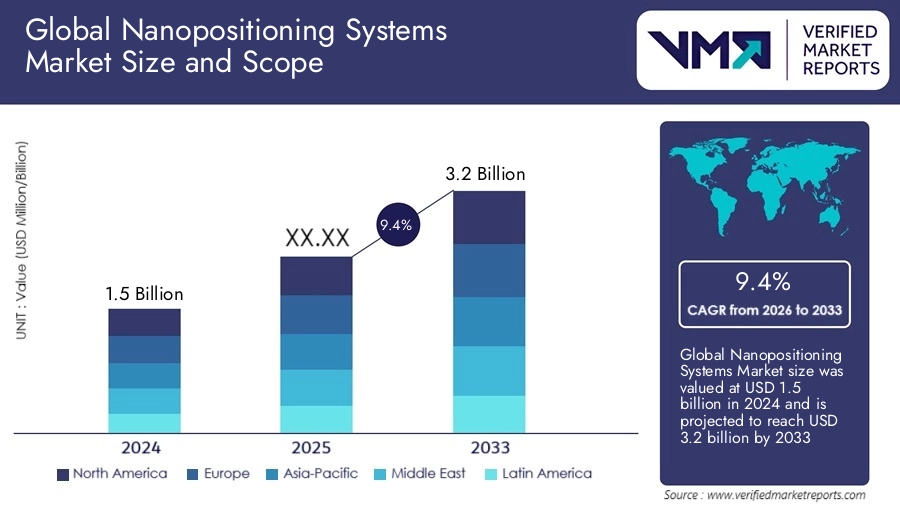
- Market Size (2026): USD 1.8 Billion (estimated)
- Forecast Value (2034): USD 4.5–5.2 Billion
- CAGR: 10.5-11.8% (approx.)
- Key Growth Driver: Increasing demand for ultra-precision in semiconductor and life science applications
Key Takeaways
- Semiconductor manufacturing continues to anchor demand, especially with advanced chip fabrication requiring nanometer-level accuracy.
- Integration of AI into motion control systems is improving real-time adjustments and predictive maintenance.
- Emerging technologies like quantum computing are opening entirely new use cases for ultra-precise positioning.
- Automation in manufacturing is accelerating adoption, as precision directly impacts productivity and quality.
- Advancements in piezoelectric materials are enabling faster, more stable, and energy-efficient systems.
- Asia-Pacific is becoming a critical growth region due to its strong electronics manufacturing ecosystem.
Top Trends
1. Semiconductor-Driven Precision Demand
- Overview (100 words): Semiconductor manufacturing is pushing the limits of precision, and nanopositioning systems are at the heart of this evolution. From wafer alignment to lithography, even the smallest deviation can impact yield and performance. As chip designs move toward smaller nodes, positioning accuracy must improve accordingly. This trend matters because semiconductors are foundational to modern technology, powering everything from smartphones to AI systems. The growing complexity of chip architectures is making ultra-precise motion control a non-negotiable requirement, ensuring consistent demand for advanced nanopositioning solutions.
- Why This Trend is Emerging (70 words): Demand for high-performance computing, AI, and 5G technologies is accelerating chip innovation. Smaller transistors require tighter tolerances, increasing reliance on precision systems.
- Real-World Example (70 words): :contentReference[oaicite:0]{index=0} integrates nanopositioning systems into its lithography machines, enabling the production of advanced semiconductor nodes.
- What It Means for the Market (70 words): Sustained investment from semiconductor manufacturers ensures stable revenue streams and continuous innovation in positioning technologies.
- What Comes Next (60 words): Further advancements will focus on improving speed and accuracy simultaneously, supporting next-generation chip fabrication processes.
2. AI-Enabled Motion Control Systems
- Overview (100 words): Nanopositioning systems are becoming smarter through the integration of artificial intelligence. Instead of relying solely on predefined parameters, these systems can now adapt in real time based on feedback. This improves accuracy, reduces downtime, and enhances overall system efficiency. The importance of this shift lies in its ability to simplify complex operations. As applications grow more demanding, AI-driven systems can handle variability without constant human intervention, making them more reliable in dynamic environments.
- Why This Trend is Emerging (70 words): Increasing system complexity and the need for automation are driving the adoption of intelligent control mechanisms that can learn and adapt.
- Real-World Example (70 words)::contentReference[oaicite:1]{index=1} offers smart controllers that optimize positioning accuracy using real-time data.
- What It Means for the Market (70 words): AI capabilities are becoming a key differentiator, pushing companies to invest in software as much as hardware.
- What Comes Next (60 words): Fully autonomous positioning systems capable of self-calibration and predictive adjustments will become more common.
3. Expansion in Life Sciences and Biomedical Imaging
- Overview (100 words): The life sciences sector is increasingly relying on nanopositioning systems for high-resolution imaging and diagnostics. Applications such as microscopy and cell analysis require precise sample positioning to achieve accurate results. As research in genomics and molecular biology advances, the need for reliable and repeatable positioning becomes even more critical. This trend is significant because it expands the market beyond industrial applications, bringing nanopositioning into healthcare and research environments where precision directly impacts outcomes.
- Why This Trend is Emerging (70 words): Growth in medical research and diagnostics is driving demand for technologies that enable detailed observation at microscopic levels.
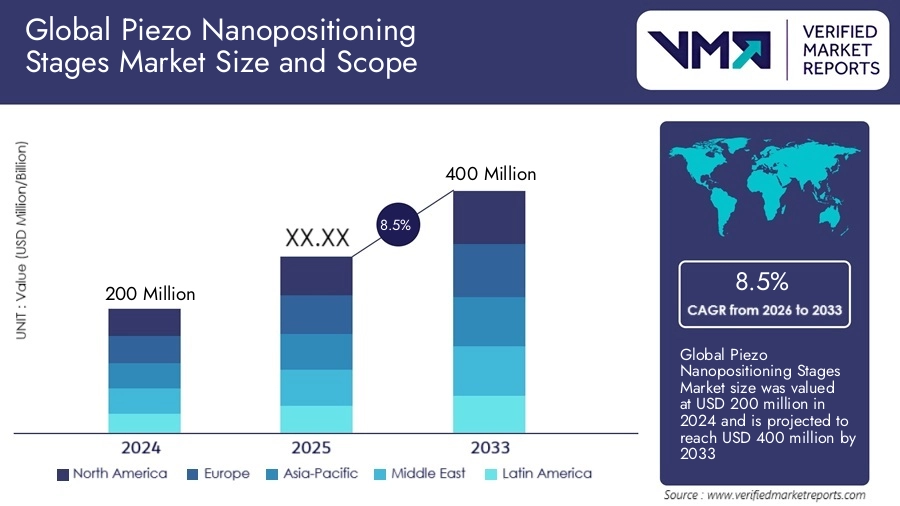
- Real-World Example (70 words): Laboratories use nanopositioning stages integrated with advanced microscopes for precise imaging in cancer research and drug development.
- What It Means for the Market (70 words): Diversification into healthcare applications broadens revenue streams and reduces dependency on industrial sectors.
- What Comes Next (60 words): Integration with real-time imaging systems will enhance diagnostic capabilities and research efficiency.
4. Photonics and Optical Alignment Applications
- Overview (100 words): Photonics and optics require extremely precise alignment of components to function effectively. Nanopositioning systems play a crucial role in ensuring that optical elements are positioned accurately. As technologies such as fiber optics and laser systems evolve, the need for precise alignment continues to grow. This trend is important because optical technologies are becoming central to communication, sensing, and imaging applications.
- Why This Trend is Emerging (70 words): Increased adoption of optical communication systems and advanced sensors is driving demand for precise alignment solutions.
- Real-World Example (70 words): :contentReference[oaicite:2]{index=2} provides nanopositioning systems for optical testing and alignment.
- What It Means for the Market (70 words): Growth in photonics will drive innovation and expand the application scope of positioning systems.
- What Comes Next (60 words): Development of faster and more stable positioning technologies for high-speed optical systems.
5. Miniaturization Across Industries
- Overview (100 words): Devices are becoming smaller across industries, from consumer electronics to medical equipment. This shift requires positioning systems that can operate with high precision in compact environments. Nanopositioning technologies are evolving to meet these demands, enabling manufacturers to produce smaller and more efficient products. The significance of this trend lies in its widespread impact across multiple sectors.
- Why This Trend is Emerging (70 words): Consumer demand for compact and high-performance devices is pushing manufacturers to adopt precision technologies.
- Real-World Example (70 words): Electronics manufacturers use nanopositioning systems in assembling micro-scale components for smartphones and wearable devices.
- What It Means for the Market (70 words): Increased demand for compact solutions will drive innovation in system design and performance.
- What Comes Next (60 words): Further miniaturization without compromising accuracy or reliability will be a key focus area.
6. Advancements in Piezoelectric Materials
- Overview (100 words): Piezoelectric materials are central to nanopositioning systems, enabling precise motion control. Advances in these materials are improving system performance, including speed, accuracy, and durability. These improvements are making nanopositioning systems more efficient and reliable, expanding their range of applications. This trend is crucial because material innovation directly impacts system capabilities.
- Why This Trend is Emerging (70 words): Ongoing research in material science is driving the development of more efficient and robust piezoelectric components.
- Real-World Example (70 words)::contentReference[oaicite:3]{index=3} develops advanced piezo-based positioning solutions for research and industrial applications.
- What It Means for the Market (70 words): Better materials will enhance performance and open new application areas.
- What Comes Next (60 words): Development of next-generation materials with higher efficiency and longer lifespan.
7. Emergence of Quantum Technology Applications
- Overview (100 words): Quantum technologies require extremely precise control of components, making nanopositioning systems essential. These applications demand accuracy at the smallest scales, where even minor deviations can impact performance. As investment in quantum computing grows, so does the need for reliable positioning systems. This trend is significant because it represents a new frontier for the market.
- Why This Trend is Emerging (70 words): Increased funding and research in quantum technologies are driving demand for precision solutions.
- Real-World Example (70 words): Research institutions use nanopositioning systems in experiments involving quantum sensors and processors.
- What It Means for the Market (70 words): New applications will create additional revenue streams and innovation opportunities.
- What Comes Next (60 words): Closer collaboration between positioning system providers and quantum technology developers.
8. Automation in Advanced Manufacturing
- Overview (100 words): Automation is transforming manufacturing, and precision is becoming a key factor in ensuring quality and efficiency. Nanopositioning systems enable accurate control in automated processes, reducing errors and improving productivity. This trend is important because it aligns with the broader shift toward Industry 4.0.
- Why This Trend is Emerging (70 words): Manufacturers are seeking ways to improve efficiency and consistency while reducing operational costs.
- Real-World Example (70 words): Automated assembly lines use nanopositioning systems for precise component placement in electronics manufacturing.
- What It Means for the Market (70 words): Increased adoption in industrial automation will drive steady market growth.
- What Comes Next (60 words): Integration with robotics and AI for fully automated production systems.
9. High-Speed and High-Precision Convergence
- Overview (100 words): Traditionally, there has been a trade-off between speed and precision. However, modern applications require both. Nanopositioning systems are evolving to deliver high-speed movement without compromising accuracy. This trend is critical for applications such as semiconductor manufacturing and optical systems.
- Why This Trend is Emerging (70 words): Need for higher throughput and efficiency in industrial and research applications.
- Real-World Example (70 words): Semiconductor fabs use high-speed nanopositioning systems for wafer inspection and processing.
- What It Means for the Market (70 words): Demand for high-performance systems will continue to rise.
- What Comes Next (60 words): Development of ultra-fast positioning systems with minimal error margins.
Download Sample Report Now: Global Nanopositioning Systems Market Size And Forecast [2024-2030]
Impact Analysis
The nanopositioning systems market is becoming a cornerstone of precision-driven industries. As applications expand, these systems are influencing how products are designed, manufactured, and tested. The increasing reliance on precision technologies is creating both opportunities and challenges for stakeholders.
- For Investors:
- Opportunity: Strong growth potential driven by semiconductor, healthcare, and emerging technologies.
- Risk: Market sensitivity to cyclical industries like electronics manufacturing.
- For Businesses:
- Strategic shift: Investing in advanced precision technologies to enhance product quality and efficiency.
- For Startups:
- Entry opportunities: Niche solutions in AI-integrated positioning systems and quantum applications.
Regional Insights
North America remains a leader in innovation, supported by strong investments in research and advanced manufacturing. The region’s focus on emerging technologies such as quantum computing is driving demand for high-precision systems.
Europe continues to demonstrate strength in precision engineering, particularly in countries like Germany and Switzerland. The emphasis on quality and innovation supports steady market growth.
Asia-Pacific is experiencing the fastest expansion, driven by its dominant semiconductor and electronics manufacturing industries. Countries like China, Japan, and South Korea are investing heavily in advanced manufacturing capabilities.
Other regions are gradually adopting nanopositioning technologies, primarily in specialized industrial and research applications.
Competitive Landscape
The competitive environment is defined by innovation, specialization, and strategic partnerships. Companies are focusing on enhancing performance and expanding their application range.
:contentReference[oaicite:4]{index=4} focuses on integrating smart control systems with high-precision hardware.
:contentReference[oaicite:5]{index=5} is expanding its presence in photonics and optical applications.
:contentReference[oaicite:6]{index=6} invests heavily in advanced piezoelectric technologies.
:contentReference[oaicite:7]{index=7} continues to lead in semiconductor-related applications.
These players are also forming partnerships and expanding into new markets to strengthen their competitive position.
Future Outlook
Looking ahead, the nanopositioning systems market is expected to evolve into a highly integrated and intelligent ecosystem. Precision will remain the core requirement, but the way it is achieved will continue to change.
One major shift will be the move toward autonomous systems that can self-adjust and optimize performance. This will reduce complexity and improve efficiency across applications.
Another important development is the expansion into new fields such as quantum computing and advanced medical technologies. These areas will require even higher levels of precision, creating new growth opportunities.
Sustainability will also play a role, with a focus on energy-efficient designs and materials. Companies that can balance performance with sustainability will be well-positioned for future success.
Final Thought
Nanopositioning systems are becoming a critical enabler of modern technology. As industries continue to push the boundaries of precision, these systems will play an increasingly important role.
The trends shaping this market highlight a shift toward smarter, faster, and more adaptable solutions. Businesses that understand these changes and invest accordingly will be better equipped to compete.
With strong growth drivers and expanding applications, the market offers significant opportunities. The key lies in staying aligned with technological advancements and evolving industry needs.
Frequently Asked Questions
- What are nanopositioning systems used for?
They are used for ultra-precise motion control in industries such as semiconductors, life sciences, and optics. - What is driving demand in this market?
Demand is driven by the need for precision in advanced manufacturing and emerging technologies. - How does AI impact these systems?
AI enhances performance by enabling real-time adjustments and predictive maintenance. - Which region is growing fastest?
Asia-Pacific is experiencing the fastest growth due to strong manufacturing activity. - What are the future opportunities?
Opportunities include applications in quantum technologies, automation, and advanced medical systems.